Discover how AI is reshaping the freelance landscape in Latin America. From automation to premium rates, explore the skills in demand for 2026.
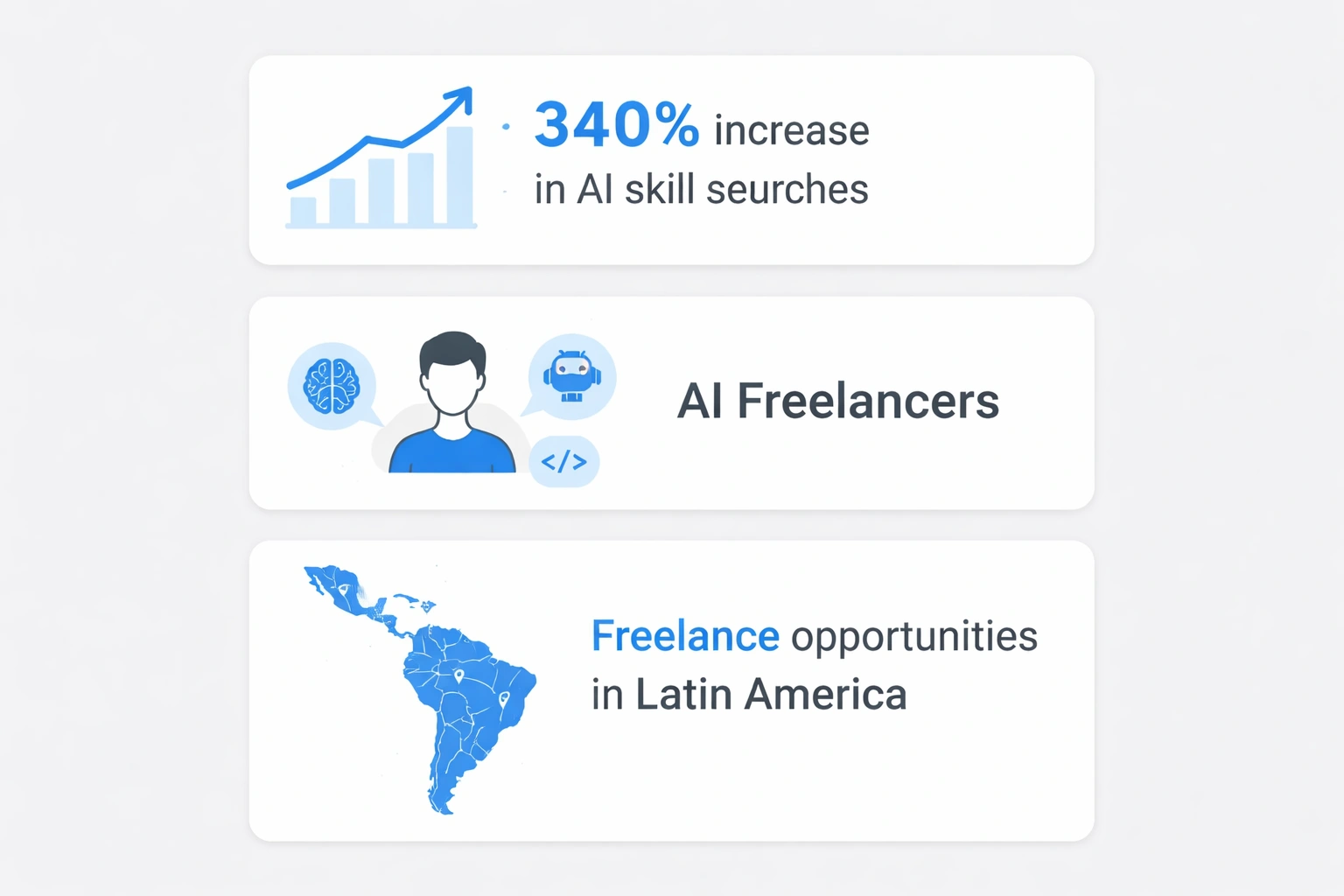
By 2026, artificial intelligence is no longer headline news in Latin America's freelance market — it's the daily reality. Companies are actively seeking professionals who can leverage AI tools to create content, automate processes, and build intelligent solutions. AI-specialized freelancers have become the most sought-after remote workers in the region.
This isn't a passing trend. The way businesses operate and scale has been fundamentally restructured. Freelancers who master these technologies can command premium rates from anywhere in the region, and startups are now building entire teams around these specialists — without the physical infrastructure that once seemed indispensable.
The market shifted dramatically with the mass adoption of AI tools. Projects that used to require entire teams can now be handled by a single person with the right toolkit. This has opened doors for businesses of all sizes to access specialized talent without full-time overhead.
Platforms like ProLatamWork report a 340% increase in searches for AI-related skills over the past year. Clients no longer want simple task executors — they want people who understand how to implement AI to solve concrete business problems.
Contrary to what many feared, automation didn't kill freelance work. It created entirely new job categories. Those who adopted these technologies early now lead the market, setting quality and speed standards that would have seemed impossible just two years ago.
The value is no longer in doing everything manually — it's in orchestrating intelligent systems that multiply results. A freelancer with AI expertise delivers in days what used to take weeks.
Prompt engineering leads demand. It involves designing precise instructions to get optimal results from advanced language models. Companies pay $50–$150 per hour to experts who build systematic prompts to automate content creation, data analysis, and customer support.
AI-assisted content creation specialists go far beyond using ChatGPT. They develop complex workflows combining multiple tools to produce original, SEO-optimized material adapted to different audiences — and they know how to strategically edit outputs so content doesn't sound generic and actually converts.
AI video editing has become a premium service for e-commerce and content creators. Tools like Runway, Descript, and CapCut Pro allow individual editors to produce professional content at speeds previously impossible. A single freelancer can edit 20 short videos in the time it used to take to finish two.
Conversational chatbot development is another fast-growing area. Businesses need specialists who can deploy virtual assistants using platforms like Voiceflow, Botpress, or OpenAI and Anthropic APIs — systems that handle everything from technical support to sales lead qualification.
AI marketing automation experts help small businesses compete with large ones. They build systems that segment audiences, personalize messages, optimize posting schedules, and adjust ad budgets in real time. One person manages campaigns that used to require entire departments.
No-code AI specialists democratize access to advanced technology. Using platforms like Make.com, Zapier AI, or n8n, they build complex business solutions without writing a single line of code — critical for startups that need speed on tight budgets.
Businesses face a real challenge: they need AI capabilities but can't justify expensive full-time hires for experimental projects. Specialized freelancers offer the solution: deep expertise without long-term commitments or high fixed costs.
Tech startups are building complete freelance teams for their early stages — one AI specialist to automate operations, another for content creation, and another for digital marketing. This model lets them scale without tying up capital in permanent salaries, office space, or benefits.
Implementation speed makes all the difference. An experienced freelancer can have AI systems running in weeks. An internal team takes months to hire, train, and coordinate. For companies in fast-moving markets, that agility changes everything.
Access to global talent is another advantage. Geography no longer matters. Companies can hire the best specialist for each project. Platforms like ProLatamWork facilitate these connections without unnecessary friction or excessive commissions.
Operational costs drop dramatically — no office expenses, equipment, enterprise software, or benefits. Companies pay only for results, converting fixed costs into variable ones that scale with the business.
Latin American professionals are gaining ground in the global AI services market. The combination of solid technical education, competitive costs, and time zones compatible with North America makes them highly attractive to US and Canadian companies.
Argentina, Mexico, Colombia, and Chile produce technical talent that competes with any developed market. Universities in the region have updated their curricula to include machine learning, data science, and AI development. Graduates leave with practical skills that are immediately applicable.
Competitive rates without sacrificing quality are the real differentiator. An AI expert from Argentina or Colombia can charge 40–60% less than an equivalent US professional while delivering the same technical level. That math is hard to ignore for budget-conscious companies.
Technical English proficiency has improved substantially across the region. LATAM freelancers communicate effectively about complex concepts, participate in strategic meetings, and document solutions clearly. Language barriers that once limited opportunities have nearly disappeared.
Remote work culture is deeply ingrained in the region. Latin American professionals have spent years perfecting asynchronous communication, distributed project management, and self-discipline. They're not learning to work remotely — they've been experts for years.
Early-stage startups need people who can automate workflows — connecting disparate tools into cohesive systems. Specialists implement solutions that sync CRMs, email platforms, databases, and productivity tools. The result: operations that run with minimal human intervention.
Predictive analytics and data modeling experts help startups make evidence-based decisions rather than gut calls. They build dashboards that visualize critical metrics, identify patterns in user behavior, and predict trends. This intelligence separates products that scale from those that fail.
Conversion optimization specialists with AI change the game for budget-limited startups. They implement automated A/B testing, dynamic website personalization, and recommendation systems that increase sales without increasing traffic. Every visitor gets an experience optimized for their profile.
Developers who know how to integrate AI APIs let startups build sophisticated products quickly. They connect OpenAI, Google Cloud AI, AWS Bedrock, or Anthropic services into custom applications — eliminating the need to build models from scratch and dramatically accelerating time to market.
Freelancers specializing in AI content strategy help startups compete in saturated digital markets. They use semantic analysis tools to identify content gaps, optimize for voice search, and generate ideas based on emerging trends the competition hasn't spotted yet.
Modern agencies operate more like freelance talent coordinators than traditional employers. They maintain a small core of project managers and build teams project by project with specialists from networks like ProLatamWork. This model lets them offer premium services without the cost structure of traditional agencies.
The process starts by identifying each client's specific needs. An e-commerce brand might need email marketing automation, while a B2B SaaS company requires lead qualification chatbots. The agency assembles the right team of specialized freelancers for that project.
Managing distributed teams requires clear tools and processes. The best-functioning agencies use Slack or Discord for daily communication, Notion or Coda for centralized documentation, and Loom for complex asynchronous explanations. Projects are divided into weekly sprints with defined deliverables.
Retaining top talent works differently in the freelance model. The best agencies treat collaborators as long-term partners — paying on time, providing detailed briefs, sharing constructive feedback, and offering consistent project flow. That reciprocity creates relationships that last for years.
Margins improve with remote AI teams. An agency can bill clients $150–$200 per hour while paying $50–$80 to highly qualified LATAM freelancers. This economic structure lets them grow revenue without proportionally scaling costs.
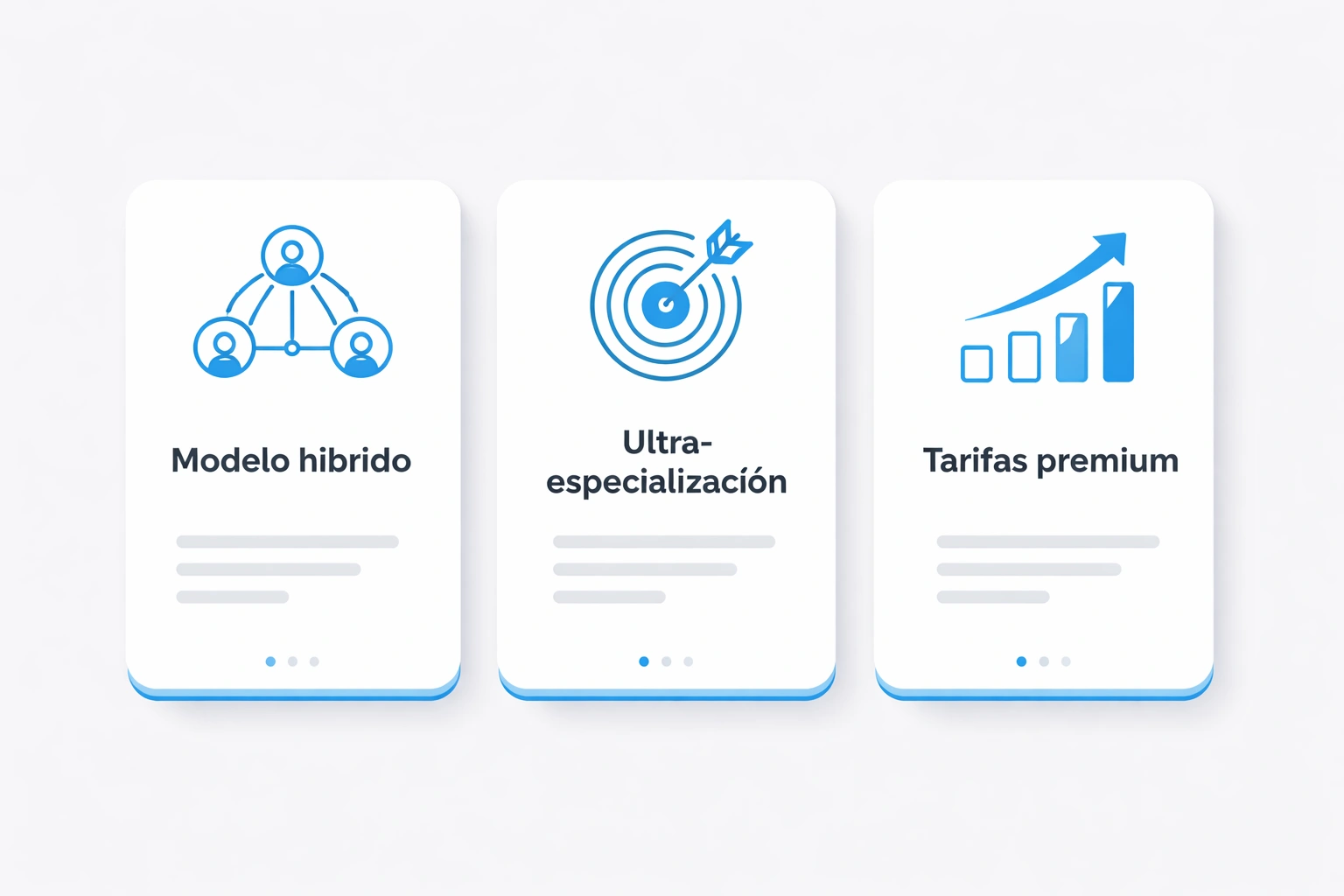
The hybrid model is here to stay. Companies discovered that distributed teams with freelance talent access outperform traditional centralized departments. This is accelerating adoption of flexible models that combine employees with external collaborators.
Ultra-specialization is replacing generalism. Clients no longer search for "graphic designer" or "web developer." They need "UX specialist for fintech apps" or "developer for Shopify-to-custom-ERP integrations." Freelancers who master specific niches charge considerably higher rates.
Milestone-based projects have surpassed hourly contracts. Companies prefer paying for specific results within defined timeframes. This benefits efficient freelancers who use AI to complete work quickly, maximizing their effective hourly rate.
Monthly retainers are growing between freelancers and recurring clients. A startup might retain an automation specialist for $3,000–$5,000 per month for ongoing support. This gives freelancers predictable income and clients guaranteed access.
Paid trial projects have replaced traditional interviews. Clients request small paid tests before larger commitments. This eliminates risk, demonstrates real capabilities, and sets clear expectations from the start.
E-commerce stores use AI for dynamic personalization of the shopping experience. A freelancer implements systems that display different products based on browsing history, purchase patterns, and similarities with other users. Conversions typically rise 25–40% with these adjustments.
Content-based businesses implement automated article generation systems that keep blogs active without large editorial teams. A specialist configures workflows that identify trending topics, generate drafts, add relevant images, and schedule posts. The human editor only refines and approves.
Professional services companies use lead qualification virtual assistants that interact with prospects 24/7. These chatbots ask discovery questions, identify budgets and urgency, and only transfer qualified leads to the sales team. Sales productivity doubles.
Coaches and consultants implement automated onboarding systems for new clients. Smart email sequences, personalized videos, and adaptive tasks guide clients without consuming the consultant's time. This scales services without sacrificing quality.
Personal brands use AI repurposing tools that convert one long video into 10+ different pieces. Clips for TikTok, carousels for Instagram, threads for Twitter, and articles for LinkedIn emerge from the original content. One creator maintains presence across multiple channels without production teams.
The platform has one clear advantage: it doesn't apply the excessive commissions typical of competitors. While other marketplaces charge 15–20% of every project, ProLatamWork maintains minimal fees that benefit both parties. More money stays with the people doing the work.
The PayPal escrow payment system provides security. Clients deposit funds that are only released upon approving deliverables. Freelancers know their payment is guaranteed when they complete work satisfactorily. This eliminates the common risk in international transactions.
The curated selection of Latin American talent ensures quality. The platform verifies skills, reviews portfolios, and confirms experience before approving profiles. Clients don't waste time filtering unqualified candidates or fake profiles.
The intuitive interface makes it easy to post projects and receive proposals in minutes. There are no complicated processes or excessive documentation. Clients describe their needs, set budgets, and start receiving relevant proposals immediately.
Spanish and English support helps resolve issues quickly. A team that understands Latin American labor dynamics provides personalized assistance — in stark contrast to global platforms where support is generic and frequently ignores regional context.
Define the specific problem before searching for talent. "I need AI" is too vague. "I need to automate lead qualification from my contact form with a chatbot that integrates with my CRM" helps you find the exact specialist.
Establish quantifiable success metrics. Instead of "improve marketing," specify "raise email open rates from 18% to 25% and click rates from 3% to 5%." This allows objective result evaluation and data-driven strategy adjustments.
Prepare the access the freelancer will need. Platform credentials, API documentation, analytics access, and examples of previous work dramatically accelerate project kickoff. Freelancers can start immediately instead of waiting days for permissions.
Assign an internal contact who can make decisions and give fast feedback. Projects stall when approvals require multiple review layers. One authorized person who understands the objectives keeps momentum going.
Start with a small pilot before large commitments. Pay $500–$1,000 for a proof of concept that validates the freelancer's capabilities. This small investment prevents costly mistakes on $10,000+ projects.
Human differentiation will center on strategic thinking and contextual creativity. Tools will handle operational work while elite freelancers focus on high-level decisions that require understanding the business, customer psychology, and market dynamics.
Portfolios will evolve to demonstrate the ability to orchestrate complex systems, not just isolated technical skills. Clients will want case studies where the freelancer identified opportunities, selected tools, implemented solutions, and measured results.
Specialized communities will replace generic marketplaces as the primary source of projects. The best freelancers will build reputations in specific niches and receive direct referrals. Platforms like ProLatamWork that facilitate direct connections will gain relevance.
Continuous education will be mandatory. Tools change monthly. Freelancers who dedicate 5–10 hours per week to learning new capabilities will stay relevant. Those who don't update will quickly lose competitiveness.
Hybrid business models will combine service income and digital products. A freelancer who masters automation can create templates that sell repeatedly. This diversification provides financial stability and scales income beyond available personal time.
The Latin American freelance market is experiencing its best moment. The combination of technical skills, early AI adoption, competitive costs, and remote-first culture positions the region as a global leader in digital talent. Companies that understand this now will have a significant advantage in the next decade.